
Some perspectives on the notion of Urbanity and Rurality
Down to the countryside.

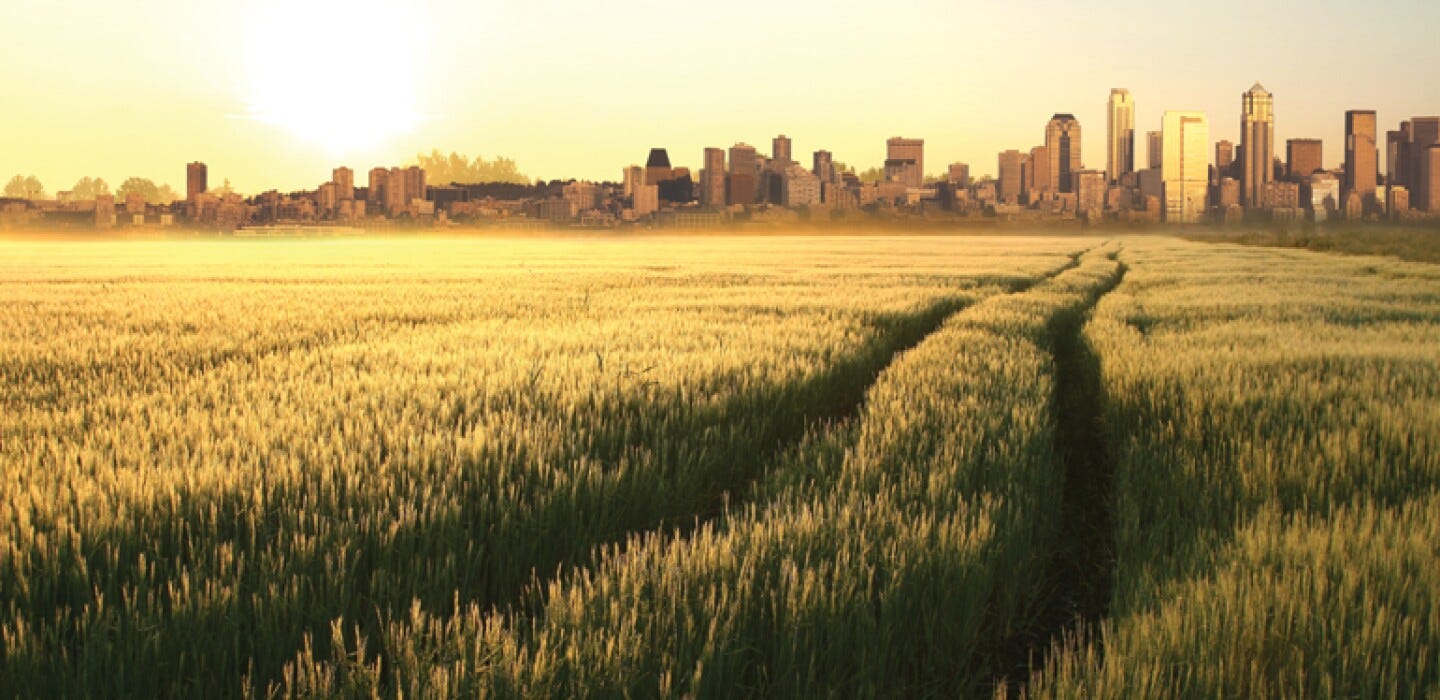
When confronting the modern world we are met with certain clear and distinct dualisms. One particular dualism which is firmly rooted in the modern age is that of the urban and the rural. While town and country is a sociological distinction as old as civilization itself, it is only in the modern industrial capitalist context where the polis and the countryside are drawn into such sharp and acute distinction, largely due to the rapid and unprecedented growth of the former at the seeming expense of the latter. As of 2007, for the first time in human history, most human beings live and reproduce themselves in urban environments and it’s estimated that by 2050 that will increase to ⅔ of the population (Ritchie & Roser, 2018). This transformation has not been without immense contradictions as well as developments in urbanisation that have raised questions about the fuzziness at the edges of what exactly constitutes urbanity and the way these categories break down in different contexts. The history of urbanisation and the nature of the relationship it has with the rural is something human geographers, sociologists, and economists have attempted to grapple with for decades in addition to questions regarding the planetary nature of globalisation that the world-market has brought. Additional questions have been raised in the latter half of the 20th century and to this day regarding the various post-industrial urban forms and how they relate to globalised urbanisation. Furthermore the blurring of these categories that has come with the era of instant communication in the information age further confounds and draws this dualism into question.
What is Urbanity and Rurality and how do they relate theoretically and historically?
From the beginning, urbanity and rurality were mutually dependent categories. The process of urbanisation can be understood as the modern phenomenon unique to the capitalist mode of production and the industrial revolution where the city transformed into an agglomeration of people and production, where capital in the form of factories, infrastructure, transportation, and the large pools of landless labourers would concentrate. That landless labour was made landless through the revolutions in agriculture which mechanised food production in the countryside alongside land reform which enclosed the commons (Boyle, 2014). The flight from the country while not total has more or less been completed in the developed West where the majority reside in cities and this process is currently underway globally. The urbanisation of the first world corresponded to bringing all four corners of the Earth into commercial unity and as the cost of labour rose in the developed world, transnational producers outsourced their production to the global south which accelerated planetary urbanisation. China is the most keen example of this with just under 20% living in cities in 1980 which has risen to over 63% in 2021 (World Bank, 2021), coinciding with the development of China from a “backwards” mostly agrarian economy into the largest industrial economy in the world it is today. It’s this global perspective of urbanisation which, alongside the aforementioned quality of concentration, Brenner and Schmid (2017) also attribute the quality of “extension” in which in the modern age there is no square inch of the earth which is unmarked by the consequences of urbanisation. This notion, that the world-market itself “universalises the urban” challenges the neat duality of urban and rural. In traditional pre-modern societies the market, the place of commerce, was geospatially limited. The level of transportation and communication technology was limited to the horse and cart with letters and goods being slow moving and more or less localised. The extension of the market to all four corners of the world, enabled by steamships and other technology, brought, in the age of colonisation, the whole world into West’s orbit. The colonial metropoles’ relationship with the colonised world is arguably the first example of Brenner and Schmid’s notion of planetary urbanisation but indeed rather than erasing the dualism between urban and rural in the process of extension, colonialism deepened and globalised this contradiction. In a related manner urbanity relates almost parasitically in relation to rural spaces as the material premises of the former find themselves in the latter. Both in the above mentioned landless labour and surplus food production but in addition the great bulk of primary resource extraction necessary for urbanised industrial commodity production takes place in ruralised spaces and in particular, colonized ones. Urbanity is also the concentration of the modern state machinery in which a polity’s authority and the regulatory-administrative apparatus which the modern nation state necessitates is exercised. Rurality in this sense can be seen as the “limits” or the margins of state control over human communities with the capacity to surveil and govern. Taken in this manner rurality can be conceptualised as a “generalised periphery” in relation to the centres of capital agglomeration and administration.
The Internet and the Urban/Rural divide
The line between this sense of urban and rural or the more generalised conceptual tool of core and periphery is being blurred in that no inch of the earth can escape the global reach of the world-market and the industrial-capitalist world-system as mentioned above but even more pressingly because of the recent revolution in communications technology which has created more strange and obscure relationships between these categories. The instant communication of the internet flattens all spatial and temporal differences and, alongside anonymity, the result is that the digital “space” is a kind of “non-space” and as such all “netizens” are cosmopolitans of a sort, devoid of the particularities of their embodied spatial realities which are provincial by contrast. The radical democratisation of the internet permits manner by which ruralised subjects exist alongside more traditionally urbanised ones. The form this takes is both an amplification of “marginalised voices” to a degree hitherto impossible and also the enabling of rogue actors disrupting the regulatory-administrative state. Since the populist elections of Brexit and Donald Trump in 2016, mainstream discourses around “misinformation” by the existing power centres have grown louder and correspondingly the response has been to reestablish “digital walls” to protect against the proverbial barbarians at the proverbial gates. However this digital blurring of the continuum between categories does not actually eliminate the underlying embodied contradiction between urbanised and ruralised subjects that these digital representations are mere reflections of. Those real political struggles can be seen both internal to the west (with the verbiage of the “fly over state” or the “heartland” being in some way estranged from the administrative centres of the nation-state, usually centred around coastal port cities for historical reasons) and internationally between the developed post-industrial west and the global periphery where industrial production, alongside the older form of raw resource extraction, has been exported. Indeed these two are deeply connected under the banner of planetary urbanisation as the populism internal to the west has been attributed to deindustrialisation of what were good paying union jobs being outsourced to the developing world (Essletzbichler, Disslbacher, & Moser, 2018). These contradictions are inextricably connected and multivariate. In this way rurality and urbanity can be reframed in the terms of colonial discourses both from the traditional perspective of western imperialist metropoles in relation to the colonized east/south but indeed also internal to the very countries these metropoles take as their material premises, between ruralised Anglo-Europeans and those same colonial urban metropoles of imperialist admistration.
Different Urbanisations
These contradictions internal to the west and the urbanisation of the global south being interlinked bring out a different challenge to the conceptual dualism of urban and rural and the post-industrial city brings this to the foreground. The industrialisation and urbanisation of the post-colonial world, having corresponded to the hollowing out of the industrial sector of the west where urbanisation, industrialisation and capitalism was born, is the context of the transformation which has been described as the west becoming “post-industrial”. This has translated to the contemporary urban-form where traditional western centres of manufacturing are absent and what remains are centres of finance, mid to high end retail, and the broader service economy (Petit, 2013). This process has also been culturally understood as gentrification where the industrial working class which traditionally defined a key aspect of western modern capitalist urbanity has been displaced by new denizens of largely professionals, managers, and bohemians. The gentrification of the post-industrial urban space, illustrative by the image of the abandoned industrial warehouses transformed into trendy coffee houses and other stereotypical “hipster” enterprises demonstrates that there indeed are different urbanities, that the urbanisation of the 19th and early-mid 20th century are in some way qualitatively distinct from the newer form of urbanisation both in terms of economic activity and culture. This necessity for capital to build up one form of urbanisation only to move, transform, and leave to rot others is a tendency attributable to the liquid nature of capital (Harvey 2012). The “left behind” urbanities can be argued are, while “spatially urban”, not “(con)temporally urban” and in this sense form a “rurality” of their own. The American “rust belt” relates to the latest form of urbanism not dissimilarity to a rural American town.
Conclusions?
What the exploration of the categories of rural and urban reveal is how much history and complexity is creeping beneath the surface of such terms. A short exploration into the history of the modern urban space reveals how tied up with globalisation, industrialisation, and capitalist relations these monolithic entities of concrete, steel and individual and corporate bodies really are. These relations indeed are planetary in scale, the fact that a “simple” metropole is but a node in a global world wide web of commerce, exchange, information, and people demonstrates how even the most remote of places cannot escape the “totalising” expanse of a globalised urbanity. This dynamic is quite acute in the information age where space and time themselves become non-factors. And yet at the same time this “totalisation” is only relatively totalising with there still persisting spatial-temporal contradictions between centres of this globalised urbanity and its periphery, both internationally via the history of colonialism with the relations the colonies had with the respective imperial metropoles, relations that, while modified, still persist in the “post-colonial” era, and internally to the countries and peoples to which these colonial metropoles exist off the backs of. All these factors display both the usefulness and the limitations of the concepts of urban and rural and a critical examination shows that where one begins and one ends is often a matter of context.
Bibliography:
Boyle, M., 2014. Human Geography: An Essential Introduction. John Wiley & Sons.
Brenner, N. and Schmid, C., 2017. Planetary urbanization. In Infrastructure Space (pp. 37-40). Ruby Press.
Essletzbichler, J., Disslbacher, F., & Moser, M. (2018). The victims of neoliberal globalisation and the rise of the populist vote: a comparative analysis of three recent electoral decisions. Cambridge Journal of Regions, Economy and Society, 11(1), 73–94. https://doi.org/10.1093/cjres/rsx025
Harvey, D. (2012) Rebel cities : from the right to the city to the urban revolution. London: Verso.
Petit, P., 2013. Slow growth and the service economy. Bloomsbury Publishing.
Ritchie, H. and Roser, M. (2018) Urbanization - Our World in Data, Our World in Data. Available at: https://ourworldindata.org/urbanization (Accessed: 30 May 2023).
World Bank (2021) Urban population (% of total population) - China, World Bank Open Data. Available at: https://data.worldbank.org/indicator/SP.URB.TOTL.IN.ZS?locations=CN (Accessed: 30 May 2023).
Genshin impact is the greatest socialist invention known to man